
Web design is the practice of planning how a website looks, reads, and behaves for real people. It is not the same as "making pretty pages." It is the set of decisions that answer: Can someone find the pricing? Do they trust you in the first ten seconds? Can they complete the task on a phone on spotty data?
Development writes the logic. Design chooses the experience. Both need each other.
The core parts of web design
1. Layout and structure
Layout is where things sit on the screen: header, navigation, hero, sections, footer. Good layout creates a visual order so the eye knows what to read first.
Example: A software development company South Africa landing page might put a clear headline, one proof point (years shipped or industries served), and a single primary button above the fold. Everything else supports that path.
2. Typography
Typeface choice, size, line length, and heading hierarchy affect readability more than most founders expect. On the web, body text around 16–18px with comfortable line height beats trendy thin fonts that fail on mobile.
3. Colour and contrast
Colour carries brand and accessibility. Contrast ratios matter for WCAG (Web Content Accessibility Guidelines) compliance. A green "Book now" button that fails contrast checks is a design failure, not a developer bug.
4. Imagery and iconography
Photos, illustrations, and icons should reinforce the message, not decorate empty space. For local businesses, authentic imagery often outperforms generic stock.
5. Interaction design (UX)
UX (user experience) covers flows: sign-up, checkout, contact, search. Wireframes and prototypes live here. A contact form with twelve fields is a UX decision that will hurt conversions regardless of framework.
6. Content design
Words on the page are part of design. Headlines, button labels, error messages, and empty states should sound human and specific. "Submit" is weaker than "Send my brief."
Web design deliverables (what you actually get)
Depending on scope, a web design engagement may include:
| Deliverable | Purpose |
|---|---|
| Mood board / references | Align on visual direction early |
| Wireframes | Structure without final visuals |
| High-fidelity mockups | Pixel-close screens for key pages |
| Design system tokens | Colours, type, spacing for dev handoff |
| Responsive breakpoints | Phone, tablet, desktop behaviour |
| Prototype (Figma, etc.) | Click-through for stakeholder review |
Not every project needs all of these. A five-page marketing site might stop at mockups plus a simple component list. A product with dashboards needs a system.
Examples in the wild
Marketing site for a founder. Hero states the outcome ("Book occupational health slots in under two minutes"), social proof, FAQ, one CTA to WhatsApp or a quote form. Design job: trust and clarity.
Marketplace. Separate mental models for customer, provider, and admin. Design job: role-based navigation and status labels people understand ("Accepted", "On the way", not internal codes).
Content site or blog. Readable article width, table of contents, related posts. Design job: typography and scan-friendly headings (like this page).
Web app dashboard. Tables, filters, empty states, loading skeletons. Design job: density vs clarity, not brochure aesthetics.
I have shipped products such as ClinicPlus and the Laundry Marketplace where design and engineering were one conversation, not a handoff war.
Web design vs web development
| Web design | Web development |
|---|---|
| What users see and how they move | How the system runs and stores data |
| Figma, tokens, prototypes | React, APIs, databases, hosting |
| Accessibility intent | Semantic HTML, ARIA, performance |
| Brand and conversion | Security, integrations, scaling |
You can launch a rough site with templates and skip formal design. You cannot skip intent. Even template sites fail when hierarchy and copy are unclear.
If you want the technical side spelled out, read What is web development? next.
Web design vs "just use a template"
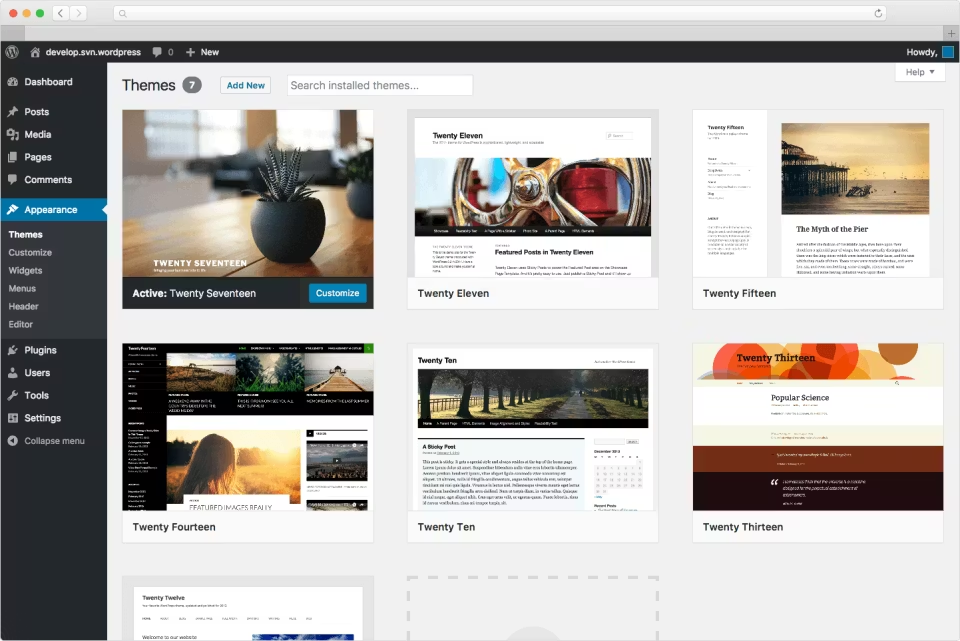
Templates (WordPress themes, Webflow, etc.) are valid for speed. Design still matters because you must configure hierarchy, spacing, and content. A template with weak copy and twelve menu items feels amateur.
AI UI tools (for example Vercel v0) can accelerate visual exploration. Treat output as a draft. Your brand, accessibility, and component consistency still need a human pass before production.
How web design connects to an app development company
When clients ask me for custom software development, design questions show up immediately:
- Who is the primary user on mobile?
- What is the one action we optimize for?
- What proof reduces anxiety (logos, case studies, guarantees)?
- What happens after they click the CTA?
Those answers shape the mockups and the sprint plan. Skipping them creates rework when development discovers the checkout flow does not fit the hero promise.
For broader engineering offerings, see Services. Industry-specific pages live under solutions (digitisation and web presence) and related routes.
What good web design achieves
- Clarity: Visitors know what you do within seconds.
- Trust: Visual polish matches the price you charge.
- Conversion: One obvious next step per page.
- Accessibility: More people can use the site, including on older phones.
- Maintainability: Developers inherit spacing and components, not one-off chaos.
When to hire design help
Hire or contract design when:
- You are repositioning or launching a new product line.
- Conversion is flat and analytics show drop-off on key pages.
- You need a design system for a growing team.
- Regulated or enterprise buyers expect polish.
You can keep design lean when you are pre-PMF and testing one offer with a single landing page. Still test hierarchy and CTA copy.
Working with a developer in South Africa
I am Ayabonga Qwabi, based in Queenstown, Eastern Cape, with about ten years building on the web and in the cloud (GCP, AWS, Azure). I work in React, Node, TypeScript, and Python, and I care about design handoff enough to argue about button labels before we wire Paystack.
If you have mockups already, we can implement. If you have only a brief, we can define structure together before code.
Next step
- Get a structured quote for scope, timeline, and budget ballpark.
- WhatsApp me with a link to your current site or a Figma file.
- Browse Services for technical co-founder and product engineering work.
Good web design is the difference between "we have a site" and "the site pulls its weight."