Family History · Eastern Cape · South Africa
The Qwabi Family
AmaQithi Clan, San People of Lady Frere and the White Kei River
The Qwabi family are San (AbaThwa) people of the AmaQithi clan, from the banks of the White Kei River in Lady Frere, Glen Grey, and Cacadu in the Eastern Cape. Part of the Joka family lineage, their roots predate the Thembu settlement of the region. This page documents verified oral history, GEDCOM lineage, and historical evidence for anyone researching the Qwabi surname, the AmaQithi clan, or San history in the Eastern Cape.
Ancestral territory: Agnes, Qithi, and Rhodana
This map shows the key sites of Qwabi and AmaQithi history in the Lady Frere area. Agnes (top left) marks the White Kei River homeland of the Joka family and Chief Madolo's people. Qithi Village (centre) is the ancestral San settlement adjacent to the Thembu Great Place at Rhodana (bottom). Mkapusi marks the Qwabi homestead.
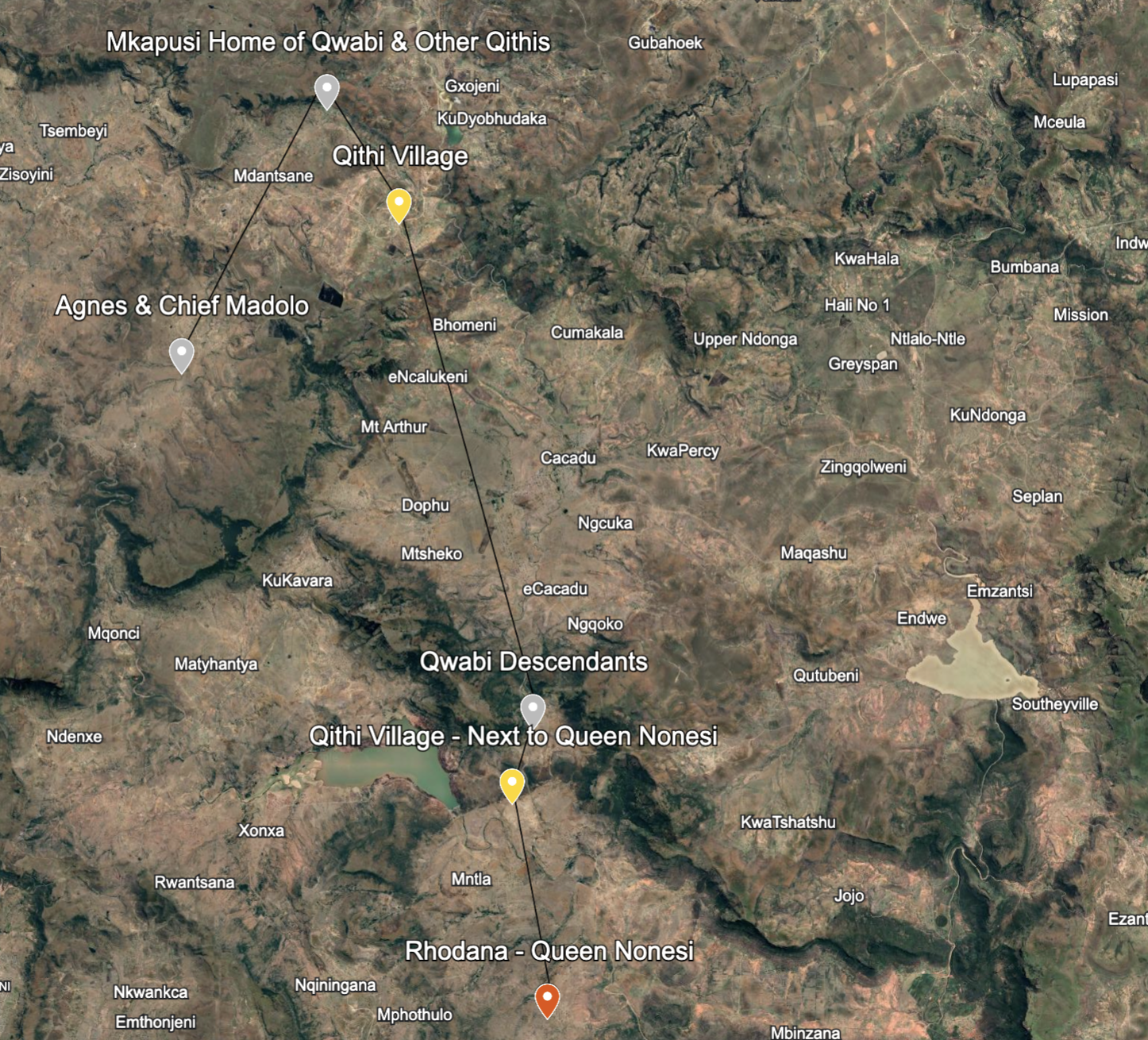
Pins: Agnes / Chief Madolo territory (top left), Mkapusi / Qwabi home (top), Qithi Village (centre), Qwabi Descendants settlement (centre-right), Qithi Village next to Queen Nonesi's Great Place (lower centre), Rhodana (bottom).
Who are the Qwabi family?
The Qwabi family are a South African family of San (AbaThwa) descent, belonging to the AmaQithi clan. Their roots lie in the Joka family, San people from the banks of the White Kei River in the Lady Frere, Glen Grey, and Cacadu district of the Eastern Cape.
The earliest confirmed ancestor is Joka, whose homestead was in or near the village of Agnes on the White Kei River. Historical records place San families under and around Chief Madolo in this exact area from the 1830s through the 1850s. The Joka family is believed to be among the San clans who lived under or alongside Madolo's authority during that period.
From Joka came Qwabi Joka (born c. 1842), the ancestor from whom the Qwabi surname is taken. His children, grandchildren, and descendants form the Qwabi family as it exists today, spread across the Chris Hani District, with concentrations in Hala 2, Queenstown, and Ndlovukazi (Lesseyton).
The Qwabi family are not Thembu by origin. They are San people who, like the broader AmaQithi clan, assimilated into the AbaThembu nation over generations of coexistence, intermarriage, and political integration in the Cacadu basin.
"At about this time a number of Thembu groups living on the White Kei, including 'Jumba', father of the Thembu chief, 'Umgudhluwa', were on comparatively friendly terms with San 'families and clans' living in that area."
Silayi (subject of Chief Jumba), recorded by Sir Walter Stanford (Macquarrie 1962:31)
Origins: the White Kei River and Chief Madolo
The White Kei River (also known as the Cacadu River) was one of the last strongholds of autonomous San life in the Eastern Cape. In approximately 1835, the San chief Madolo (also known as Madura or Madoor) relocated his people from the Klipplaats and Upper Black Kei rivers to the Glen Grey area near Lady Frere, north of the Black Kei.
In 1839, missionary James Read established a Bushman School on the White Kei River. By 1842, fifteen San families lived there. Madolo attended services at the chapel but never personally converted. This settlement, and the village of Agnes on the White Kei banks, was the heartland of San life in the Lady Frere area during the years when Qwabi Joka was born and raised (c. 1842).
The Joka family is believed to be part of the San clans who lived under or in proximity to Madolo's authority. Around 1850, colonial pressure and conflict with Thembu settlers forced Madolo and the remaining San to retreat to caves along the White Kei, and by 1856 Madolo and the remnant of his tribe withdrew into the Maloti-Drakensberg mountains, disappearing from the historical record. The families who remained, including the Joka family, assimilated into the local Thembu and Xhosa populations.
c. 1835
Chief Madolo relocates San clans to Glen Grey / Lady Frere area
1839
Bushman School established on the White Kei River by missionary James Read
c. 1842
Qwabi Joka born near Agnes / White Kei River, Lady Frere
1846
Madolo leads 200 followers (San, Khoe, Mfengu, Thembu) as British levies in the War of the Axe
c. 1850
Madolo forced to retreat to caves on the White Kei; San and Thembu relations intensify
1856
Madolo and remaining San withdraw to the Maloti-Drakensberg; those who remain assimilate
The AmaQithi clan: San people who became part of the Thembu nation
The AmaQithi (also written amaQithi, Qithi clan, or Mqithi clan) are a San (AbaThwa) clan whose ancestral village, Qithi, is located in the Lady Frere area of the Eastern Cape, directly adjacent to Rhodana, the Thembu Great Place established by Queen Nonesi in 1841.
The AmaQithi are not a Thembu clan by origin. Contrary to accounts that describe Qithi as a son of Ntande and therefore a Thembu ancestor, the evidence points elsewhere. The name Qithi contains the palatal click consonant Q, which is indigenous to Khoisan (San) languages, not Bantu languages. The Nguni peoples absorbed click consonants through centuries of deep contact with Khoisan peoples. A Thembu ancestor with an authentic Bantu name would not carry a Q click. The name "Mqithi" is described by researchers as a "linguistic fossil" that combines a standard Xhosa personal prefix with a traditional San phonetic root.
The true lineage of the San chief Qithi (Mqithi) is still under active research. What is documented is that by the time Queen Nonesi moved the Thembu Great Place to Rhodana in 1841, a San leader named Mqithi was already there. His clan was granted land at Qithi Village, positioned directly next to the Thembu royal residence, a placement that indicated high rank comparable to a senior counselor.
The AmaQithi served the Thembu in specialized roles that drew on their unique knowledge as First People of the land: rainmakers during droughts, frontier scouts using their knowledge of the terrain, elite marksmen during conflicts like the War of Mlanjeni (1850-1853), and herbalists providing medicinal knowledge from local flora.
The Rhodana / Qithi relationship is visible on the map today. Qithi Village sits at the boundary of what became Rodana Village, and the Rodana Clinic and Rodana PJS School are located immediately adjacent to the historic Qithi site, confirming that these two communities, one San in origin, one Thembu, grew up literally side by side.
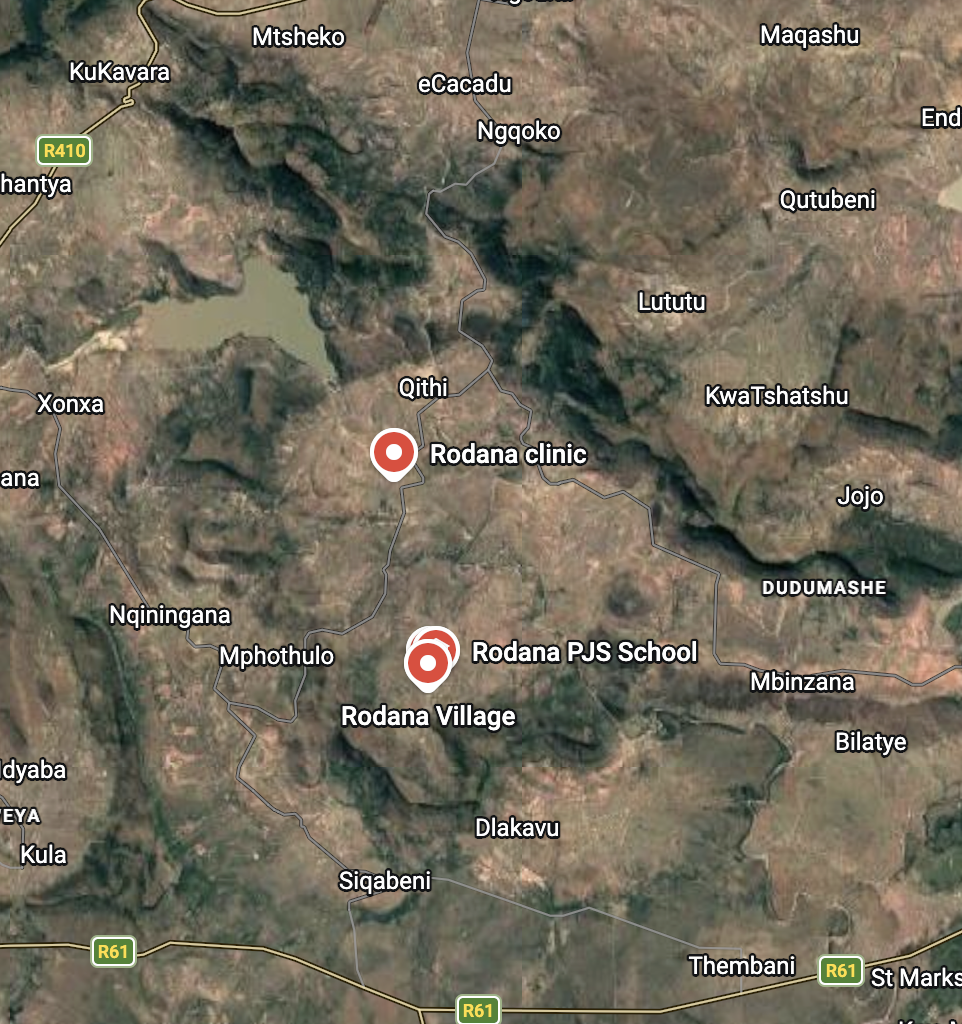
Qithi Village (top centre) sits directly adjacent to Rodana Clinic and Rodana Village (centre and bottom), the site of the Thembu Great Place under Queen Nonesi. The San presence at Qithi predates the Thembu arrival at Rhodana in 1841.
AmaQithi izibongo (clan call names / praises)
These are the traditional izibongo (praises) of the AmaQithi clan, recited in Xhosa. They are the call names that identify the clan and distinguish it from the AbaThembu izibongo.
Ndinga, Mnono, Rhadu, Mlebe, Nomsobodwana, Sopitsho Ngqolomsila, Yemyem, Nkomo ayizali izala ngokuzaliswa, Xa ingazali, izala ngokumiselwa. NgamaQithi amahle neenzipho zawo. Izinto ezingahlal'esitulweni, zihlala esitulweni sodaka.
Note on Thembu call names
The AmaQithi do not use Vela bambhentsele, Zondwa, or MThembu as their primary izibongo. These belong to the AbaThembu clan. Vela bambhentsele is the praise of Bhomovi, given to him because he was allowed to choose a Sotho woman of his liking (it means "the one the women lust after"). Zondwa is a Thembu descendant and chief. MThembu is the clan name itself. Because the AmaQithi have assimilated into the Thembu nation, it is not frowned upon to also call Thembu clan names when reciting izibongo.
AmaQithi families beyond the Qwabi line
The AmaQithi clan extends beyond the Qwabi family. Multiple AmaQithi family branches are documented across the Eastern Cape and Free State.
Lady Frere and Cala region: AmaQithi families are found in Lower Seplan, Qugqwaru, Bholoto, Tsembeyi, Hala 2, and Ngcuka. Surnames associated with Qithi families in this area include Tshabe, Mbaba, Ngubo, Shumana, Khethelo, and Mhlungulwa.
Ngcobo: AmaQithi families trace their origin to the Rhodana area. One documented lineage records that Manimani left Lady Frere (Rhodana) and settled in Maqwathini, Engcobo. The Nkosikho Manimani line in Engcobo Kumadanga traces back through Sinduwamba, Sipenisi, Poto, Manimani, Phonye, and Dolo. AmaQithi villages in Ngcobo include Gubenxa, Lucwecwe, Lahlangubo, eMadladleni, Gqutyini, Zadungeni, and Qumanco. Surnames: Mgengwana, Ntulo, Limba, Gobelo, Titi, Kula, Msebe, Skampula, Matho, Tyhokolo, and Fanakho.
Cofimvaba: The original Qithi family history records that the first Qithi people to arrive in the area were Ngcongolo and his brother Mafilika, who came from Cofimvaba (Shobeni) and settled on the red wall on top of the white hill where the Cacadu basin begins. AmaQithi surnames in Cofimvaba include Ngqela, Bambatha, Mtshabe, Skeyi, Sokutapa, and Ndaleni.
Free State: AmaQithi families from Mcambalala in Luxeni (Lady Frere) settled in the Free State. Surnames include Plata and Mfumba.
Documented Qwabi family lineage
Verified through GEDCOM records, oral history from family elder Monwabisi Qwabi, civil registration archives, and historical documentation of the White Kei San communities.
Earliest known ancestor
Joka
The Qwabi family belongs to the Joka family, San (AbaThwa) people from the White Kei River basin in the Lady Frere district. The earliest verified ancestor in our line is Joka, whose homestead was in or near the village of Agnes on the banks of the White Kei River. It is believed the Joka family were among the San clans who fell under the authority of Chief Madolo, who led San people in this region from around 1835 until 1856.
2nd Generation
Qwabi (son of Joka)
Qwabi Joka (born c. 1842) is the ancestor from whom the Qwabi surname derives. He was born in the White Kei / Agnes / Mqithi area and grew up in a period when San families were actively negotiating their place alongside Thembu chiefs in the Cacadu basin. He fathered four known children: Nosenti (born 1861), Bushman, Halile Jonas, and Molosi (Oliphant). He died in 1915.
3rd Generation
Bushman, Halile Jonas, Molosi (Oliphant)
Three sons of Qwabi Joka who established the main family branches. Bushman was named explicitly to preserve San identity. Halile Jonas joined the Church of God and Saints of Christ and died in the Bulhoek Massacre of 1921. Molosi was named after Chief Moorosi of the Phuti people, a close ally of the San. The name Moorosi was difficult for Xhosa speakers to pronounce and evolved into Molosi.
4th Generation
Bhangile, Dumile, Yanki, George, and others
Bhangile (son of Halile Jonas, 1913-2003) inherited Bushman's homestead in Skhwanqeni then later settled in Hala 2. Dumile (son of Molosi) was a World War 2 veteran who founded Qwabi Primary School and helped establish Hala 2. Yanki (son of Molosi) also served in World War 2.
Full ancestor tree (Joka to present)
The complete GEDCOM-verified descendant tree is published in the detailed family history article. It covers all known branches: the House of Bhangile (Hala 2), the House of Dumile (Hala 2 / Lady Frere), the House of Yanki (Queenstown and beyond), the House of George, and the Bushman line.
Read the full Qwabi family history articleMolosi, Bushman, and the naming tradition
The names Qwabi Joka gave his sons were not accidents. They were deliberate statements about who the family was and where they came from.
His son Bushman (Boesman) was named directly for what the family was: San people. In 19th-century Eastern Cape usage, "Bushman" was the colonial and Afrikaans term for the San (AbaThwa). Giving a child this name in that era was an act of identity preservation, not shame.
His son Molosi was named after Chief Moorosiof the Phuti people. Moorosi was one of the greatest San allies in Southern African history. He had San ancestry on his mother's side, had two San wives, witnessed San rock painters at work, and during Moorosi's War of 1879, San fighters armed with bows and arrows fought alongside his forces. The password used by Phuti warriors to access Moorosi's mountain stronghold during the eight-month siege was "Moroa", the Xhosa word for Bushman. When Moorosi fell in November 1879, the San lost their most powerful protector.
Because Xhosa speakers found "Moorosi" or "Morosi" difficult to pronounce, the name evolved in family use to Molosi. He was also nicknamed Oliphant (elephant) by the Boer family his mother worked for, reportedly because he was short, very strong, and had bow legs. Molosi fathered the largest branch of the Qwabi family, including Dumile, Yanki, Varhile, George, and others.
Notable figures in Qwabi family history
Qwabi Joka (born c. 1842, died 1915)
The founding patriarch of the Qwabi surname. Son of Joka, born near the village of Agnes on the White Kei River in Lady Frere, in the territory of San chief Madolo. Fathered Nosenti (born 1861), Bushman, Halile Jonas, and Molosi. Died 1915.
Bushman (Boesman) Qwabi
Named 'Bushman' by his father Qwabi Joka to preserve the family's San identity. Youngest of the three sons. Had only daughters, so asked his brother Halile Jonas to send his son Bhangile to manage his homestead in Skhwanqeni. Worked in Steynsburg around 1915-1919.
Halile Jonas Qwabi
Son of Qwabi Joka. A devout member of the Church of God and Saints of Christ (AmaSirayeli). Died in the Bulhoek Massacre of 1921, buried in a mass grave. The apartheid government erased civil death registrations for the victims. His son Bhangile carried his legacy as 'Sirayeli' in Hala 2.
Molosi (Oliphant) Qwabi
Son of Qwabi Joka, named after Chief Moorosi of the Phuti people (San ally). Nicknamed 'Oliphant' (elephant) for his strength and bow-legged build. Fathered the largest branch: Dumile, Yanki, Varhile, George, Kholiwe, Nobhayisekile, Roro William, Bennet, Caroline, and others.
Bhangile Qwabi (1913-2003)
Son of Halile Jonas. Born in Glen Grey. Inherited Bushman's homestead in Skhwanqeni around 1958. After losing four children to pneumonia, relocated to Hala 2 near Lady Frere. Known throughout Hala 2 as 'Sirayeli' after his father's faith. Died 2003 in Lady Frere.
Dumile Qwabi
Son of Molosi. World War 2 veteran. Founded Qwabi Primary School in Lady Frere. Among the first settlers of Hala 2, granted land by Paramount Chief Kaiser Matanzima. Helped Bhangile's family relocate to Hala 2. His children: Malungelo, Poto, Mziwamadoda, Queen, Malungisa, and Yamkela.
Yanki Qwabi
Son of Molosi. World War 2 veteran. Married Agnes Evelina Ntlabati on 30 December 1947 in Queenstown. Fathered ten children: Zolelwa, Tenjiwe, Lindiwe, Neliswa, Sipho Rosin, Fumanekile, Boniswa, Mzukisi, Ntobeko, and Nomaphelo.
Qwabi family locations in the Eastern Cape
The Qwabi family's documented geographic footprint spans several villages and districts in the Eastern Cape, all within or adjacent to the Chris Hani District.
Agnes, White Kei River (Lady Frere)
The original homeland of the Joka family, the Qwabi ancestors. Agnes is a village on the banks of the White Kei River in Lady Frere. It was the territory of San chief Madolo and his people from around 1835. Qwabi Joka was born here around 1842.
Mkapusi (Lady Frere)
The Qwabi family homestead in the Lady Frere area. The map shows Mkapusi as the "Home of Qwabi and Other Qithis", close to Qithi Village and the White Kei River cluster.
Qithi Village (Lady Frere)
The ancestral village of the AmaQithi clan, named after the San leader Mqithi. Located directly adjacent to Rhodana, the Thembu Great Place. The Qwabi family, as AmaQithi, trace their clan origins to this village. Qithi Village predates the Thembu settlement at Rhodana (1841).
Hala 2 (near Lady Frere)
Established with significant contributions from Dumile Qwabi. The House of Bhangile and the House of Dumile live primarily here. Bhangile's family relocated from Skhwanqeni after hardship. Bhangile died here in 2003.
Skhwanqeni (Eskwanqeni)
The homestead village of Bushman Qwabi, in close proximity to Qithi Village. Bhangile Qwabi lived here from around 1958 until relocating to Hala 2. The Gudu family (related through Qwabi Joka's brother's line) still live here, as do some Gudu descendants in Steynsburg.
Ndlovukazi (Lesseyton)
Home to a branch of the Qwabi family. Caroline Qwabi was born and died here. Some family members continue to live in this area.
Queenstown
Several Qwabi family marriages are recorded in Queenstown: George Qwabi (1939), Amoria Qwabi (1942), and Yanki Qwabi (1947). Branches of the Yanki and Roro William Qwabi lines remain here.
Qwabi Village, Bulhoek
A village named Qwabi exists in the Bulhoek area near Queenstown in the Chris Hani District. Its ancestral connection to the Qwabi family lineage is under ongoing research.
Steynsburg
The Qwabi family worked in Steynsburg around 1915-1919. Mashiya Qwabi (son of Bushman) died there in November 1919 at age four. One Qwabi family member later settled there permanently and changed his surname to Pini.
Military tradition in the Qwabi family
The Qwabi family has a documented tradition of military service across multiple generations and conflicts, consistent with the broader San alliance history in the region.
- Chief Madolo led 200 followers, a mixed force of San, Khoe, Mfengu, and Thembu, as British levies during the War of the Axe (1846). The Joka family, as San people under or near Madolo's authority, lived through this era of frontier conflict.
- Qwabi Joka participated in frontier conflicts of the late 1800s. He named his son Molosi after Chief Moorosi, under whom San bowmen fought against British colonial forces in Moorosi's War (1879).
- Dumile Qwabi and Yanki Qwabi (sons of Molosi) both served in World War 2. Dumile returned to found Qwabi Primary School and help establish the Hala 2 community.
- Molosi (Oliphant) Qwabi also served as a soldier.
- In more recent generations, Monwabisi Qwabi, the late Rosin Qwabi, and Xolile Qwabi continued the family tradition of military service.
Frequently asked questions about the Qwabi family and AmaQithi clan
- Who are the Qwabi family?
- The Qwabi family are a South African family of San (AbaThwa) descent, belonging to the AmaQithi clan. They trace their roots to the Joka family from the banks of the White Kei River in the Lady Frere, Glen Grey, and Cacadu district of the Eastern Cape. They are not Thembu by origin but have assimilated into the AbaThembu nation over generations. Today the Qwabi surname is concentrated in the Chris Hani District, with branches in Hala 2, Queenstown, and Ndlovukazi (Lesseyton).
- Where does the Qwabi surname come from?
- The Qwabi surname comes from an ancestor named Qwabi, son of Joka, born around 1842 near the village of Agnes on the White Kei River in Lady Frere. The Q click consonant in "Qwabi" is a linguistic marker of San (Khoisan) heritage, not a Bantu-origin name. Click consonants in Xhosa and Zulu were absorbed from Khoisan languages through centuries of contact and intermarriage.
- Are the Qwabi family San people?
- Yes. The Qwabi family are San (AbaThwa) people by origin. Their ancestor Joka lived on the White Kei River in territory associated with San chief Madolo. The name "Bushman" was deliberately given to one of Qwabi Joka's sons as an act of identity preservation. The AmaQithi clan name itself carries a San phonetic root. The family assimilated into the AbaThembu nation over time but their San origin is documented in oral history, place names, and the linguistic roots of their clan name.
- What is the AmaQithi clan?
- The AmaQithi (also written as amaQithi or Mqithi clan) are a San clan whose village, Qithi, is located in the Lady Frere area directly adjacent to Rhodana, the Thembu Great Place established by Queen Nonesi in 1841. The AmaQithi are not Thembu by origin. Qithi is a San leader whose lineage is still under research. The clan name contains a palatal click consonant indigenous to Khoisan languages. The AmaQithi assimilated into the Thembu and served as rainmakers, frontier scouts, and elite marksmen. Their presence at Qithi Village predates the Thembu settlement at Rhodana.
- What are the AmaQithi clan praises (izibongo)?
- The AmaQithi izibongo (clan call names) are: Ndinga, Mnono, Rhadu, Mlebe, Nomsobodwana, Sopitsho Ngqolomsila, Yemyem, Nkomo ayizali izala ngokuzaliswa, Xa ingazali, izala ngokumiselwa. NgamaQithi amahle neenzipho zawo. Izinto ezingahlal'esitulweni, zihlala esitulweni sodaka. The AmaQithi do not use the Thembu call names Vela bambhentsele, Zondwa, or MThembu as their primary izibongo because those belong to the AbaThembu clan. However, because the AmaQithi have assimilated into the Thembu nation, it is not frowned upon to also call Thembu clan names when reciting izibongo.
- Who was Chief Madolo and what is his connection to the Qwabi family?
- Chief Madolo (also known as Madura or Madoor) was one of the most powerful San leaders in the Eastern Cape. Around 1835 he led his people to the Glen Grey area near Lady Frere, the same territory where the Joka family (Qwabi ancestors) lived. In 1839, missionary James Read established a Bushman School on the White Kei River where fifteen San families lived by 1842, the same year Qwabi Joka was born. It is believed the Joka family were among the San clans under Madolo's leadership or living in close proximity to his people in the Agnes / White Kei River area.
- Why was Molosi named after Chief Moorosi?
- Qwabi Joka named his son Molosi (also written Molose) after Chief Moorosi of the Phuti people. Moorosi was one of the greatest allies the San ever had. He had San ancestry on his mother's side, had two San wives, witnessed San artists painting in caves, and his fighters used the Xhosa word for Bushman ("Moroa") as the password to access his mountain stronghold during Moorosi's War of 1879. San bowmen fought alongside Moorosi's forces during that war. Because Xhosa speakers could not easily pronounce "Moorosi" or "Morosi", the name became Molosi in family use.
- Is Qithi a Thembu chief or a San chief?
- Qithi is a San chief, not a Thembu chief. Contrary to some accounts that describe the AmaQithi as a Thembu clan descended from a Thembu ancestor named Qithi son of Ntande, the historical and linguistic evidence points clearly to San origin. The name Qithi contains a palatal click consonant that is not native to Bantu languages. The Qithi village sits directly next to Rhodana, where the Thembu only arrived in 1841. The AmaQithi predate the Thembu at that location. The true lineage of the San chief Qithi/Mqithi is still under active research.
- Where do the Qwabi family live today?
- The Qwabi family is concentrated in the Chris Hani District of the Eastern Cape. Primary family branches live in Hala 2 (near Lady Frere), Queenstown, and Ndlovukazi (Lesseyton). There is also a village named Qwabi in the Bulhoek area near Queenstown. Individual Qwabi family members are spread across South Africa, including Gauteng and the Western Cape.
- Who founded Qwabi Primary School?
- Qwabi Primary School in Lady Frere was founded by Dumile Qwabi, a World War 2 veteran and son of Molosi (Oliphant) Qwabi. Dumile was among the first residents of Hala 2 and was granted land there by Paramount Chief Kaiser Matanzima.
- What happened to Halile Jonas Qwabi?
- Halile Jonas Qwabi was a devout member of the Church of God and Saints of Christ (AmaSirayeli). He died in the Bulhoek Massacre of 1921. He is buried in a mass grave, and the apartheid government erased civil death registrations for the victims. His son Bhangile was later known throughout Hala 2 as "Sirayeli" in memory of his father's faith.
- Is the Qwabi family related to Qwabi Hotels?
- No. The Qwabi family are a South African family from Lady Frere in the Eastern Cape, with San origins in the AmaQithi clan. Qwabi Hotels and Game Reserve is a commercial business. It shares the name but has no known connection to the Qwabi family lineage documented here.
Are you a Qwabi family member or AmaQithi descendant?
This record is a living document. If you have photos, oral histories, corrections, or additional genealogical records for the Qwabi family or AmaQithi clan, please reach out. The goal is a complete, verified record for our children and grandchildren.
Contact us about the Qwabi family or AmaQithi clanKey search terms
Qwabi family history Eastern Cape · Qwabi surname origin · Joka family Lady Frere · AmaQithi clan · AmaQithi San clan · Qithi clan Eastern Cape · AmaQithi izibongo · Mqithi clan · Qithi Village Lady Frere · Rhodana Qithi history · AmaQithi AbaThwa San · White Kei River San people · Agnes Lady Frere San · Chief Madolo San Eastern Cape · Qwabi Joka family history · Bushman Qwabi · Molosi Qwabi Oliphant · Moorosi War San fighters · Halile Jonas Qwabi Bulhoek Massacre · Bhangile Qwabi Sirayeli · Dumile Qwabi Qwabi Primary School · Yanki Qwabi · Hala 2 Lady Frere · Chris Hani District Qwabi · Qwabi village Bulhoek · AmaQithi families Ngcobo Cofimvaba Free State