
Compiled by Ayabonga Qwabi, Namoota Technologies — namootatech.com
What is declarative programming?
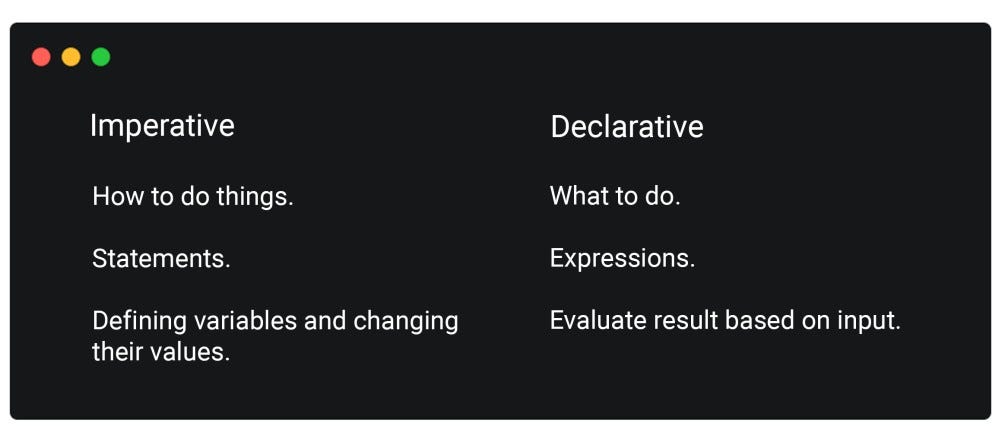
Declarative programming is a software development paradigm where the main focus is on describing what needs to be achieved or the desired outcome, rather than explicitly specifying how to achieve it. You provide declarations, configurations, or statements that outline the desired behavior.
It is called declarative because you declare what should be done rather than how. You describe the desired result; the language or runtime figures out the steps. That contrasts with imperative programming, where you list step-by-step instructions for the machine.
In imperative programming the focus is on procedures and algorithms: explicit instructions for how to reach the outcome.
Let’s simplify it further
Imperative (driving directions): “Turn left at the next intersection, go straight, then take a right onto X Street.” Step-by-step instructions.
Declarative (GPS): You enter the destination; the system computes the route. You state where you want to go; it handles how.
Declarative programming can simplify development, improve readability and maintainability, and let the system optimize execution. It can be limiting when you need fine-grained control or very complex custom logic.
Functional programming is a subtype of declarative programming: define functions, compose them, favour immutability, and avoid side effects where possible.
If we only declare the output, how does the machine know the steps?
The runtime, framework, or engine interprets your declarations and maps them to concrete operations — via libraries, optimizers, or internal rules.
- You define the desired outcome (high-level instructions or config).
- The system interprets those instructions.
- The system executes the necessary actions (often optimized).
- You receive the output without specifying every low-level step.
Why bother if something imperative still runs under the hood?
Declarative style abstracts implementation noise so that application code can be:
- Human-readable — reads like intent, not micro-steps.
- Maintainable — modular pieces and clearer separation of concerns.
- Abstract — reuse and manage complexity in larger systems.
- Intent-focused — less noise, clearer logic.
- Higher-level — less boilerplate when the platform gives good primitives.
- Easier to debug and test — clearer boundaries (when discipline is kept).
Declarative programming does not replace imperative code everywhere; it layers over it. The right mix depends on the problem and the tools you use.
Examples: HTML, CSS, SQL
HTML
HTML describes structure and content; the browser decides how to lay it out and paint.
<!DOCTYPE html>
<html>
<head>
  <title>Declarative Example</title>
</head>
<body>
  <h1>Welcome to Declarative Programming!</h1>
  <p>This is an example of declarative HTML.</p>
  <ul>
    <li>Item 1</li>
    <li>Item 2</li>
    <li>Item 3</li>
  </ul>
</body>
</html>
CSS
You declare presentation; the engine applies it.
h1 {
  color: blue;
  font-size: 24px;
}

p {
  color: green;
}
SQL
You declare the result set; the database plans and executes the query.
SELECT first_name, last_name
FROM employees
WHERE department = 'IT'
ORDER BY last_name;
In each case you focus on what; the system handles much of the how.
Declarative programming and abstraction
In its purest form, declarative programming is closely tied to abstraction: separating what (behaviour you want) from how (implementation). That separation supports readability, maintenance, and staying close to the problem domain.
Declarative apps with functional JavaScript
Building declarative-style apps in JavaScript often combines several ideas. Below: composition, partial application, currying, point-free style, typing notes, combinators, and containers for state.
Function composition
Composition chains functions so the output of one feeds the next. It matches declarative style: express a pipeline of transformations instead of manual sequencing.
Composition has deep roots in lambda calculus: functions can take functions and return functions.
Basic composition
Composition assembles smaller blocks into larger behaviour. In functions, you chain steps so each step receives the previous step’s output.
const add = (x) => x + 2;
const multiply = (x) => x * 3;
const composedFunction = (x) => multiply(add(x));
const result = composedFunction(5); // (5 + 2) * 3 = 21
composedFunction first adds 2, then multiplies by 3. Composition generalizes this pattern and is a foundation for currying, partial application, and larger pipelines.
Ramda compose
Ramda’s R.compose builds a right-to-left pipeline: the rightmost function runs first.
import * as R from 'ramda';

const add = (x) => x + 2;
const multiply = (x) => x * 3;

const composedFunction = R.compose(multiply, add);

composedFunction(5); // 21
Partial application
Partial application fixes some arguments of a function and returns a new function for the rest.
const add = (x, y, z) => x + y + z;
const addFive = add.bind(null, 5);
addFive(3, 2); // 10
This supports reusable, specialized functions and fits a declarative, data-flow-oriented style.
Ramda partial
import * as R from 'ramda';

const add = (a, b, c) => a + b + c;
const addFive = R.partial(add, [5]);
addFive(2, 3); // 10

const subtract = (a, b) => a - b;
const subtractFive = R.partial(subtract, [R.__, 5]);
subtractFive(10); // 5
R.__ marks argument positions to fill in later.
Function currying
Currying turns a multi-argument function into a sequence of unary functions: each call returns the next function until all arguments are supplied.
const add = (x) => (y) => x + y;
const incrementByTwo = add(2);
incrementByTwo(5); // 7
Currying supports modularity, reuse, and composition.
Ramda curry
import * as R from 'ramda';

const add = (a, b) => a + b;
const curriedAdd = R.curry(add);

const add5 = curriedAdd(5);
add5(3); // 8
curriedAdd(2, 3); // 5
Point-free programming
Point-free (tacit) style defines functions without naming every argument, often via composition and currying. It can be concise; it rewards familiarity with your utilities.
For “square then add the original value” — e.g. (3^2 + 3 = 12) — Ramda’s converge expresses that clearly:
import * as R from 'ramda';

// x² + x  →  at x = 3: 9 + 3 = 12
const squareAndAdd = R.converge(R.add, [R.square, R.identity]);

squareAndAdd(3); // 12
Point-free style leans on abstraction, declarative pipelines, and composition; readability depends on team conventions.
Type annotations (JSDoc / TypeScript)
Annotating inputs and outputs improves safety, documentation, tooling, refactors, and clarity of intent in composed code.
/**
 * Adds 2 to a number.
 * @param {number} x
 * @returns {number}
 */
const add = (x) => x + 2;

/**
 * Multiplies a number by 3.
 * @param {number} x
 * @returns {number}
 */
const multiply = (x) => x * 3;

/**
 * Adds 2, then multiplies by 3.
 * @param {number} x
 * @returns {number}
 */
const composedFunction = (x) => multiply(add(x));

composedFunction(5); // 21
Hindley–Milner style as documentation
JavaScript does not infer ML-family types natively, but Hindley–Milner-like comments document contracts:
functionName: (Arg1) => (Arg2) => Return
/**
 * add: (number) => (number) => number
 * @param {number} x
 * @returns {(y: number) => number}
 */
const add = (x) => (y) => x + y;

/**
 * multiply: (number) => (number) => number
 */
const multiply = (x) => (y) => x * y;

/**
 * composedFunction: (number) => number
 */
const composedFunction = (x) => multiply(add(x)(2))(3);

composedFunction(5); // 21
Laws of composability
Laws help reason about composed systems.
Law of identity
Composing with an identity function should not change behaviour.
import { compose } from 'ramda';

const identity = (x) => x;
const multiplyByTwo = (x) => x * 2;
const composed = compose(identity, multiplyByTwo);

composed(5); // 10
Law of association (composition)
For function composition, associativity means ((f \circ g) \circ h = f \circ (g \circ h)): grouping of composed functions does not change the result.
(Array map/reduce examples mix different operations; true associativity of composition is best illustrated directly with compose or pipe.)
Function combinators
A combinator is a higher-order function that builds new functions from simpler ones, typically without free variables — only parameters matter.
Purpose: combine functions so output flows through a chain (like compose).
Common JavaScript combinator sketches
// identity (R.identity)
const I = (x) => x;

// constant (R.always)
const K = (x) => (y) => x;

// apply (R.call)
const A = (f) => (x) => f(x);

// thrush (R.applyTo)
const T = (x) => (f) => f(x);

// duplication
const W = (f) => (x) => f(x)(x);

// flip (R.flip)
const C = (f) => (y) => (x) => f(x)(y);

// compose (R.compose)
const B = (f) => (g) => (x) => f(g(x));

// substitution (S combinator sketch)
const S = (f) => (g) => (x) => f(x)(g(x));

// converge-style (related to R.converge)
const S2 = (f) => (g) => (h) => (x) => f(g(x))(h(x));

// on (R.on)
const P = (f) => (g) => (x) => (y) => f(g(x))(g(y));
Free variables
A free variable is used inside a function but bound in an outer scope rather than declared inside the function.
function outerFunction() {
  const outerVariable = 'Hello';

  function innerFunction() {
    console.log(outerVariable); // free variable from outer scope
  }

  innerFunction();
}
Pure functions
A pure function always returns the same output for the same input and causes no observable side effects.
function add(a, b) {
  return a + b;
}
State management in declarative apps
Containers
Containers hold application state in a structured, predictable way. Many designs favour immutability: updates produce new values instead of mutating old ones.
Why they matter:
- Predictable central state.
- Immutability reduces accidental coupling.
- Separation of state logic from UI.
- Reuse of stateful modules.
- Performance options (e.g. shallow equality in subscribers).
- Scale as features grow.
Redux
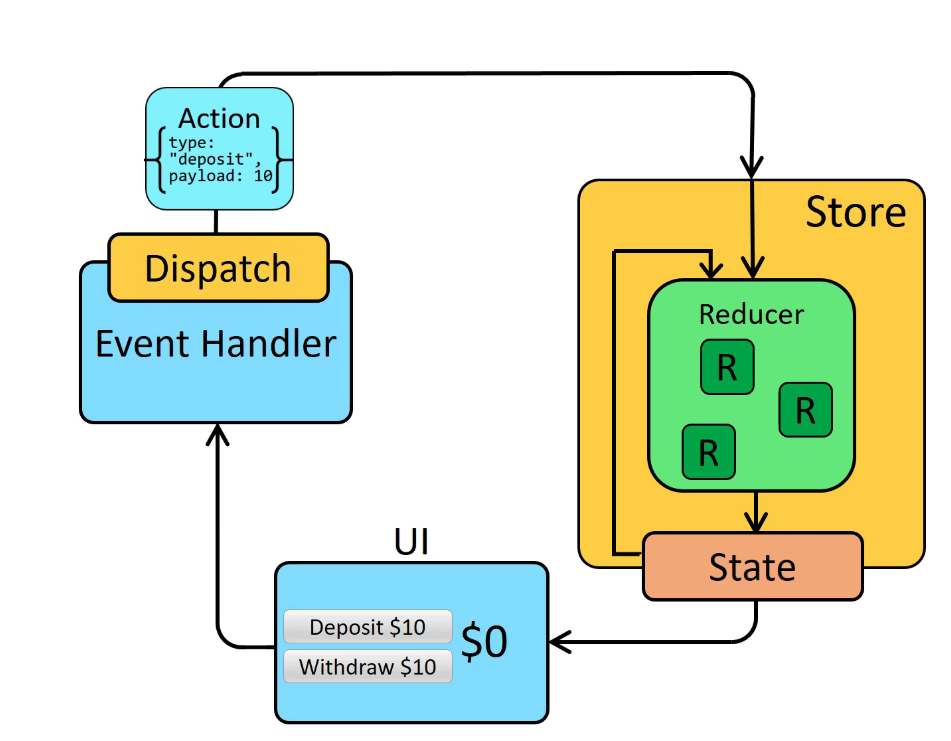
Redux keeps state in a single store (container). Updates are described by actions and applied by pure reducers that return the next state object.
// store.js
import { createStore } from 'redux';
import rootReducer from './reducers';

const store = createStore(rootReducer);
export default store;
// reducers.js
const initialState = { count: 0 };

const counterReducer = (state = initialState, action) => {
  switch (action.type) {
    case 'INCREMENT':
      return { ...state, count: state.count + 1 };
    case 'DECREMENT':
      return { ...state, count: state.count - 1 };
    default:
      return state;
  }
};

export default counterReducer;
// CounterComponent.jsx
import React from 'react';
import { connect } from 'react-redux';

const CounterComponent = ({ count, increment, decrement }) => (
  <div>
    <p>Count: {count}</p>
    <button type="button" onClick={increment}>
      Increment
    </button>
    <button type="button" onClick={decrement}>
      Decrement
    </button>
  </div>
);

const mapStateToProps = (state) => ({ count: state.count });

const mapDispatchToProps = (dispatch) => ({
  increment: () => dispatch({ type: 'INCREMENT' }),
  decrement: () => dispatch({ type: 'DECREMENT' }),
});

export default connect(mapStateToProps, mapDispatchToProps)(CounterComponent);
References
- X-Team — Functional programming, composition, associativity
- TheEvilSoft — YouTube
- Ramda — Documentation
- LinkedIn Learning — Building declarative apps using functional JavaScript
- ChatGPT — chat.openai.com (research / drafting aid)
- GitHub gist — Combinators reference
- The Codest — Power of functional programming in JavaScript, part 2 — combinators
- InterTech — Redux: when and why to use a state container